Carpet & pad
Carpet stretched in tight and seamed where feet don't cross
Carpet and pad for bedrooms, dens, stairs, and commercial spaces, power-stretched at install and seamed out of the walking lanes so it lies flat for years instead of months.
Chapter 01
Where a carpet job comes apart before you notice
A ripple in a carpet almost never means bad carpet. It means the stretch was skipped. Carpet and the pad underneath both give a little as people walk on them and as a room heats and cools through the year, and if the installer only knee-kicked the carpet into place instead of running a proper power stretch across the whole room, there was never enough tension in it to take up that give. The wave shows up first at doorways and at the top of a staircase, which happens to be exactly where feet cross the carpet most and where the give has nowhere to hide.
Seams tell the same story a different way. We see it in older Rankin County homes more than new construction: a seam run down the center of a bedroom, or straight across a doorway threshold, that looked fine the week it was laid and started separating a year or two later because foot traffic kept catching the edge of it. Once a seam opens, dirt works into it and it only gets more visible from there.
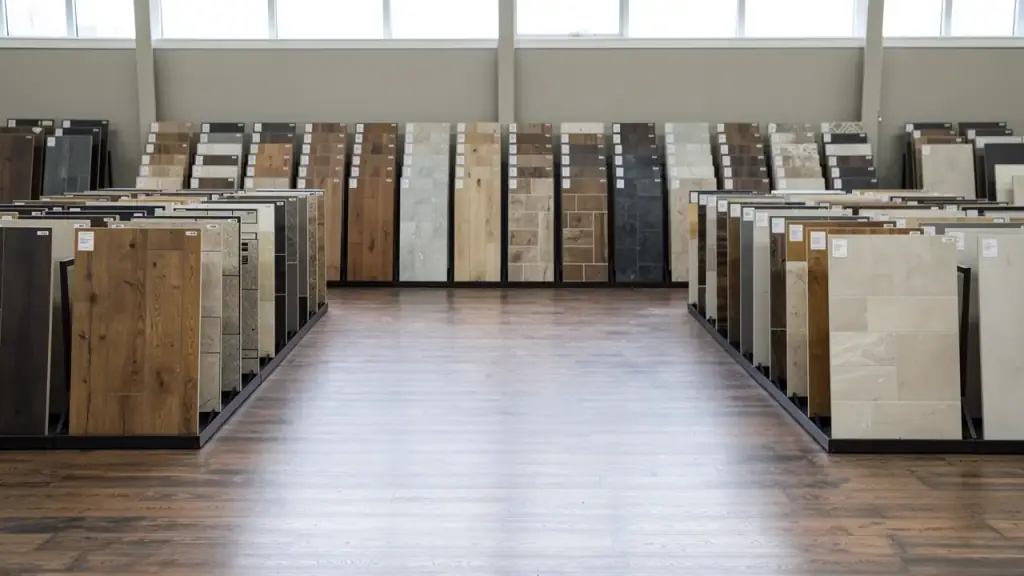
Rows of upright plank and tile sample boards standing in a flooring showroom
How we stretch, pad and seam a room
Power stretching is the difference. A stretcher anchors against one wall and pulls the carpet taut against the opposite wall before it is tacked down, which puts real, even tension across the whole floor instead of whatever tension a knee-kicker can manage a foot at a time. It costs more time on install day, and it is the reason a properly stretched carpet still lies flat five years later instead of rippling by the second winter.
Pad choice matters almost as much as the carpet itself. A thicker, softer pad feels good underfoot in a bedroom but breaks down faster under a rolling desk chair or steady foot traffic, so we match pad density to the room: firmer under stairs and in dens that see daily use, a little more give in a bedroom that mostly sees bare feet and a made bed.
Seam placement is planned before the carpet is ever cut, not decided on the fly. We run seams along the edge of a room or under a doorway threshold where they are less visible and get crossed less often, never down the middle of a walking path. Stairs get their own attention: each tread and riser is cut and tacked individually so the carpet does not shift or pull loose at the nose of the step, the spot that takes the hardest wear on any staircase.
Chapter 03
Keeping a new carpet looking new
Vacuuming on a regular rhythm, twice a week in rooms that see daily traffic, does more for how long a carpet looks new than anything else an owner controls. Grit tracked in on shoes works like sandpaper on carpet fiber every time it gets walked on and ground in, so getting it out before that happens is worth more than any cleaner on the shelf.
Spills get blotted, not rubbed. Rubbing a spill drives it deeper into the fiber and can spread a stain wider than it started; blotting from the outside edge in lifts it back out instead. A carpet that starts rippling again after it has settled in, or a seam that starts lifting at one end, is worth a call rather than a wait. (601) 591-0902 reaches the showroom on Lakeland Drive, and a re-stretch is a quick fix caught early and a bigger one caught late.
Ashley's Flooring. Call (601) 591-0902.